


Microphones thumping together like a Newton’s cradle; ultra-colorful virtual reality gameshow quests; screaming; a hushed piano symphony about war and trauma. What do all these things have in common? No, the answer is not the band Everything Everything, as Google’s AI unhelpfully suggests.
It is the sounds and sights echoing across the Lincoln Center campus as part of the three nights of the Unsound Festival, which brought together experimental artists from across the globe under the theme ‘Soft Power’.
The event, funded by the Polish government, is a “festival of contemporary, experimental and leftfield music staged in Kraków, Warsaw,” and a rotating cast of other cities. While I wasn’t totally clear on why a Polish cultural festival was being staged in New York City, I was surprised, and a little disappointed, that my train over from Greenpoint (the city’s Little Poland) on Wednesday night was not bustling with babcias looking to celebrate their heritage with free experimental music.
Night One (What Is The post-American Dream?)
The opening night of the festival, in the sold out Alice Tully Hall, was the most Experimental-with-a-capital E of the three, beginning with a collaboration between New York’s Ka Baird and Japan-based FUJI|||||||||||TA.
The 40 minutes of improvisation looked to “explore air and voice as material.” This was the type of experimental music concerned not so much with sounding good as pushing the boundaries of what sound even means; to say that they “played” their instruments – Baird with microphone and flute, FUJI|||||||||||TA with a self-designed organ pipe-turned drum – would be to use that word expansively. It sounded, to me, like a cartoon character crashing down a staircase and into a toolshed.
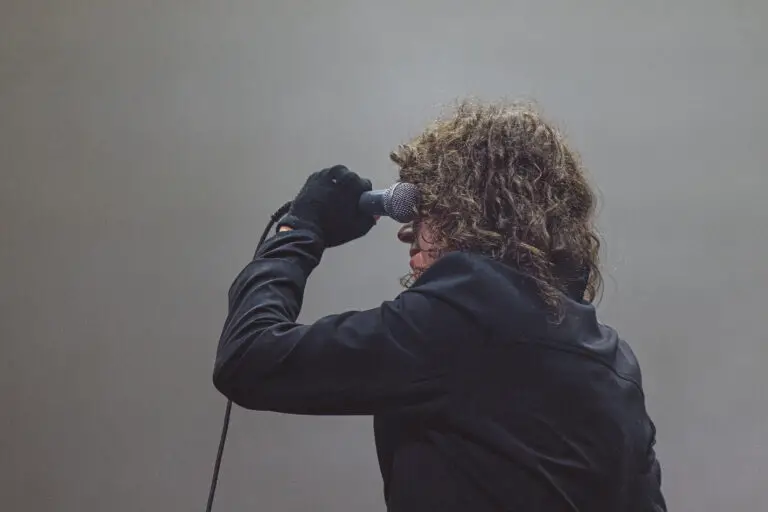
It was all so spontaneous, so fleeting, with Baird lurching about the stage and smashing things (even microphones) together, that to write about it here feels like incarcerating it, draining it of its essence.
This was followed by an audiovisual rendition of Actress’ new radical frame project, “a psycho-documentary exploring madness, the blues and the unsettling mental universe of a character.”
If the previous performance was uncomfortable sonically, radical frame inspires discomfort in a broader sense. Kick drums are high-pitched and fast-paced; usually used to give us the beat, to act as the anchor, here the kick feels more transient, an aberration. And the backdrop, flashing between saturated whites and darkness, hurts the eyes.
The performance is all about gradation. It starts off truly quiet – you can hear the proverbial pindrop, which is actually me accidentally kicking over my water bottle. But then it builds and builds and builds so that all of a sudden, without any anticipation, I feel ill-at-ease. As if he sensed this in me, he pulls back again.
At full throttle the sound system performs remarkably, thunderously well. Some loose fixture towards the back of the room is taking most of the toll, rattling about at moments, the only sign that the system was, I assume, designed for less bass-heavy music.
The pedestrian pace of the music, the smoke drifting slowly across the room, the fact that we’re all sitting down, all make it feel suddenly like someone has hit low-power mode on a nightclub crowd. Again though, as if he sensed me thinking this, the music immediately doubles in speed; there is a man two seats down from me doing a little Trump shuffle of the arms.
Towards the end of the set Actress has taken to leaning against his desk, seemingly exhausted.
“What the fuck,” someone says as the music fades out.
At this point, I felt somewhat exhausted after 2 hours of quite challenging music, and looked on nervously as the production team built the staging (including a racing-car chair on a raised stage, two television screens and a set of laptops) for the final performance from Team Rolfes, a New York-based virtual reality studio.
My trepidation was unfounded. What followed was the most entertaining, impressive, incomprehensible 45 minutes of my life.
It is one of the jobs of the reviewer, I believe, to convey the nature of the performance – even if it is just at quite a basic level. What kind of instruments did they use? How did they make it? What did it sound like?
I am forced to admit that I am unable to uphold these duties to any satisfactory degree here, and the following paragraphs are but a poor facsimile of what Team Rolfes produced. Mustang Speedrun is apparently “a road trip story told as a gameshow,” but this mega-ironic cyberplay (““If we don’t entertain them, someone else will!” flashes up on the giant LED screen) went too fast – too deep into internet culture – and with too much audiovisual stimulation for me to capture it.
There were approximately seven people on stage: four in suits on the side pressing buttons on machines, one camera operator (whose feed was shown live on the screen), and two main characters, “A” and “Z”, who were traveling through some kind of cybernetic gameshow in pursuit of a goal that eluded me (something about “re-writing the country’s founding myth.”)
Watching it felt like falling asleep and waking up in a hell, if hell was hosted on AWS and rendered in 480p.
What it lacks in standard esthetic charm or discernable relationship to its audience’s lived experience, it more than made up for in sheer depth of creativity, humor and frenetic pace.
All this is a reminder that, if these people, these humans, can produce something of this rank and originality, we certainly don’t need artificial intelligence coming anywhere near our creative pursuits. I was simply blown away.
After passing through various troubling scenes and sequences, “A” ends with a smile on their face (“Z” is writhing in the front row of the audience). So that’s a happy ending, right?
Night Two (Previously hated and now also hated)
Day 2 focused on US-Polish cultural exchange, seeing two New York-based artists teaming up with Polish counterparts and performing special commissioned works.
The first performance, hotel room by claire rousay (who dropped out of high school to become a musician aged 15, which is about as experimental as it gets), and Martyna Basta, a Polish composer, producer, and singer-songwriter, was created over two weeks in a secluded village in the Polish countryside.
The 44-minute work of ambient music concret saw Basta largely playing guitar and singing with all sorts of vocal processing while rousay tinkled on the piano and pressed buttons on her Mac, hunched over like a student before finals, all set to projections like intersecting waves or sand in the shallows of a beach. It is ghostly, inspired, I imagine, by the spooky environment it was composed in.
The second performance was between Keith “Giant Claw” Rankin and Warsaw-based soundtrack composer and performer Julek ploski entitled CONTROL FREAK. As with Team Rolfes the night before, this performance featured a bizarre movie with ironic captions, this time over the top of energetic, techno-inspired semi-improvization.
If the first performance was spooky, inhabiting the edges of the room, then this is more energetic and in your face. ploski danced about in his socks and, again, it feels a shame that the audience is seated and the most I can see is some jiggling legs.
The backdrop is as difficult to follow as Team Rolfes’, featuring clips of people in ultra-high wind simulators one moment, mundane clips of everyday life the next. The story seems to follow, in part, a humanoid creature made of toothpicks and conkers.
Night Three
If Wednesday night pushed the boundaries of what music and performance can be, and if Thursday was an intimate view into what can come out of new relationships, then Friday – a celebration of a young Polish genius and her reflection on war and trauma – was what the Lincoln Center was really made for. Culture at its Highest.
Hania Rani, from Gdańsk in Northern Poland, performed excerpts from her forthcoming Meditations followed by Non-Fiction: Piano Concerto in Four Movements.
The neo-romantic Meditations is experimental in its own way, insisting on dissonant, repeated intervals. It is mature music when held up against the most famous of her contemporaries, who seem insistent on writing unserious, tear-jerking chords.
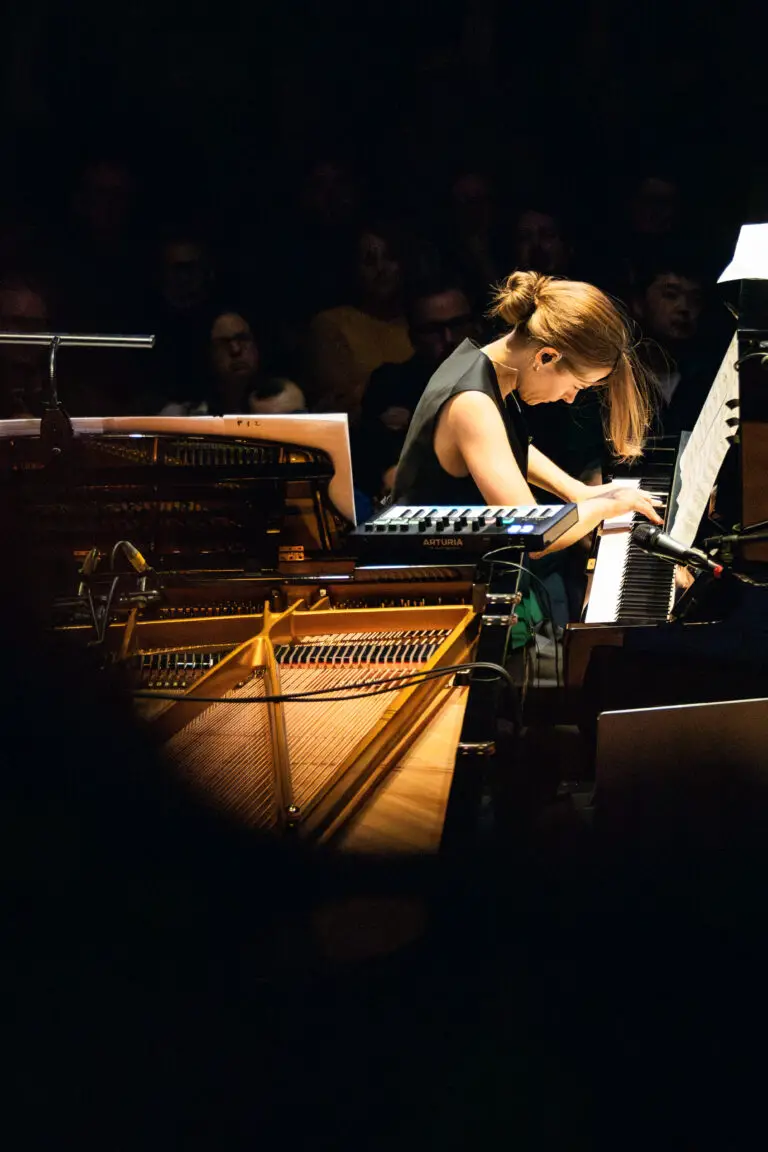
It was all chromatic, heavy on the far-left of the piano, slow to the point where notes merge into one another like watercolors running together. At times Meditations becomes more hopeful, but never for too long; there is always a return to murky left hand notes and dissonant intervals.
It is clearly a work of innovation, its minimalist inflections continuing the experimental theme of the festival. Rani makes heavy use of ostinatos, one of which, spasmodic, rapid-fire, continues for perhaps 10 minutes, a total hypnosis broken only by her own left-handed aggression.
The hall itself is a gorgeous space with an ecclesiastical aspect, the seats like pews before a stage-altar with its strange oar-like wooden beams. To the side, where we might expect stained glass, wooden panels are illuminated with projections of the Chase Bank logo (nothing is really free I suppose).
Rani is a compelling performer, sometimes frozen stiff, only her fingers visibly moving, sometimes headbanging in self-satisfaction. Her feet are as important as her hands, there is heavy sustain and dampening, all this producing so much reverberation that correspondence between sight (her hands moving) and sound (the notes those hands should be producing) completely breaks down.
What’s more, there is an effect so bizarre, yet so subtle, that I am still not sure if my mind was playing tricks on me: some of the notes seem to be bending or modulating out of tune, like a guitar string being pulled. (Think the soundtrack to Poor Things.) I had eyes on all four limbs and could not work out how it was done.
The whole thing ends shockingly, quickly, with no warming, the musical equivalent of an impish shrug. One moment there is music; the next silence.
The great conclusion to the festival was Rani’s Non-Fiction: Piano Concerto in Four Movements – partially inspired by the story of the young music prodigy Josima Feldschuh, who was forced into the Warsaw Ghetto during World War II (the work was commissioned when found Feldschuh’s notebooks were discovered in 2020).
The whole thing felt, despite the tragic theme of war and loss, completely fresh, in part because of the musicians: performed with the 45-piece Sinfonia Varsovia in collaboration with drummer Valentina Magaletti (who can only be described as “crisp” and is well worth watching on YouTube) and saxophonist Jack Wyllie (of, amongst others, Portico Quartet, connected to Rani presumably via Matthew Halsall’s Gondwana label).
The concerto is a work of near-ambience; the orchestra as a unit never goes past half-throttle, instead toying with typical expectations of playing styles (cf. double bass being plucked). There are elements of improvisation too: there is a timpani solo meant to reflect “rumblings of bombs and war zone,” explaining perhaps why Rani wanted an unconventional musician.
Again there is that weird sensation that something is out of tune, being bent away from center. It makes the air seem to fizz just slightly around us.
Again, as before, the piece ends without warning.
Bluesky Discussion
View on BlueskyNo replies yet. Be the first to comment on Bluesky!

Comments are closed.