


Cigarettes were cool. New York was cool. The Strokes were cool… and then they weren’t?
On September 8, music critic Steve Hyden releases his part-love letter, part-cultural examination of The Strokes and the peculiar circumstances that shaped their rise, decline, and enduring legacy. It is, as Hyden describes it, a book about “the people who wanted rock music to take over the world again,” and the fans who were ultimately disappointed by what The Strokes became.
Is This It: The Never-Ending Rise and Fall of The Strokes (And Rock ‘n’ Roll) traces the band’s life cycle, from their formation under the unpredictable Julian Casablancas to their meteoric rise, evolving sound and complicated legacy. As he writes, “they are famous for not becoming as famous as rock writers expected them to be. It created a mythos around The Strokes at a time when most bands couldn’t sustain a mythos of any kind.”
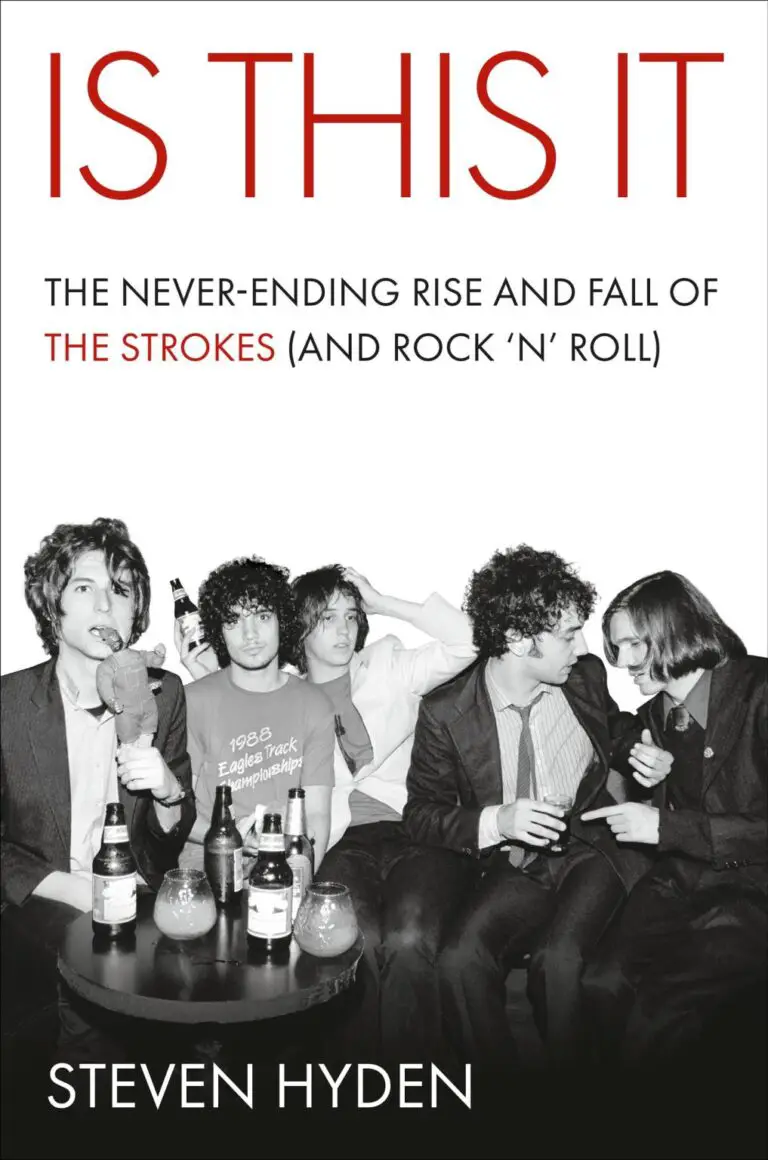
While The Strokes emerged in the 2000s, they are spiritually a 90s band, from their scrappy sound to their disdain for the mainstream and everything it represented. The so-called “gang,” consisting of Julian Casablancas, Nick Valensi, Albert Hammond Jr., Nikolai Fraiture, and Fabrizio Moretti, moved through New York City as a “singular organism” of ritualistic drinking, drugging, and late-night debauchery. Hyden follows this trajectory through the music itself, beginning with Is This It (2001) and Room on Fire (2003), both produced by Gordon Raphael, whose work helped define the band’s early sound (despite, apparently, not knowing anything about mastering tracks): blown-out vocals and a kind of calculated looseness that made the music feel simultaneously effortless and meticulously constructed.
As the band continued to cycle through producers and weather their relationships to each other, their sound changed with them. Slightly newer, but still carrying the raw edge that made them so great in the first place. By the time Rick Rubin rolled around and put his Midas touch on The New Abnormal (2020), the band had transformed from the New York kids shepherding the new rock revival into the established band that we had waited for all along. (Although I will note that Hyden has a little more love for the albums in between than some of us… cough cough.)
The most interesting bits gleaned from Hyden are less about the band itself and more about his sociological take on why we couldn’t just let The Strokes be, simply, a great rock band. He stresses the impact of individualism on the decline in rock bands’ cultural prominence. What once followed the formula of what Hyden calls the 5×5 continuum, with many of the greatest rock bands consisting of five members like The Rolling Stones, Pearl Jam and Aerosmith, is no longer ideal in a world where one artist on tour keeps costs down and means fewer egos to manage. The space where five bad boys in tight pants with cigarettes hanging out their mouths once took up residence in our hearts is now occupied by the solo act. Hyden points to technology as another force that changed how we consume music: what was intended to bring us together has also isolated us. The rock band once reflected “our own communal spaces,” which are disappearing.
The criticism of Hyden’s proximity to the band is also addressed. While he’s not a Lizzie Goodman-type distant friend or relative or insider, he writes from a familiar place, that of the everyman music listener who grew up listening to The Strokes in their bedroom in Appleton, Wisconsin. His distance from the band becomes an asset, allowing him to examine their rise and fall not as an insider, but as someone who watched it unfold alongside everyone else. And perhaps that is the only way to make sense of a band that wanted to be both wildly popular and decidedly outside the mainstream.
Ultimately, The Strokes never truly fell. Did they try too hard? Probably. Their critical reception and commercial trajectory may at times have fallen short of expectations, but their influence is impossible to dispute. To me, The Strokes have saved Rock ‘n’ Roll time and time again. A band I played with many moons ago directly ripped off nearly every song by the Strokes, and I’m sure our front man won’t be the last Brooklyn boy to do just that. Casablancas ruled Tumblr in my mid-teens and inspired a generation of horny teenagers to learn how to play guitar. And simply, they made good fucking music. Is that not enough for us?
And perhaps that is the strange thing about The Strokes: they became so important to Rock ‘n’ Roll that simply being a great rock band was never going to be enough.
Bluesky Discussion
View on BlueskyNo replies yet. Be the first to comment on Bluesky!

Comments are closed.