


Sometimes, when I listen to a piece of music, I like to think about what someone from a different time would have made of it. What would a 17th century peasant, arms sore from kneading dough, make of Yung Lean? What would her husband, back twisted over a field of cabbage, make of field John Coltrane, of anything made in Bushwick?
In most cases – in those above – I think they would be pretty horrified. Confused, if nothing else, by how alien it sounds. Like asking someone to think of a new color: it wouldn’t compute.
But in some cases, I think, our music would make total sense. Nina Simone. Hiroshi Yoshimura’s Music for Nine Postcards. I think they would get these.
I think they would get Steve Reich’s Music for 18 Musicians, too. There is something in it so fundamental, so perfect, that they would find inexorable.
But if they were on the fence – if they found it ungodly – then I think its Staged Variations at Park Avenue Armory on October 14th (running through October 18th and culminating in a talk between Reich and the event’s director Alan Pierson in conversation with Nico Muly) would have convinced them.
The evening featured three performances of the same piece – itself a daring, if challenging, proposition – set in the Armory’s staggering Wade Thompson Drill Hall. The Park Avenue Armory is a massive 19th Century gothic revival behemoth, built for the 7th New York Militia Regiment, and its Drill Hall is one of the largest unobstructed spaces in the city.
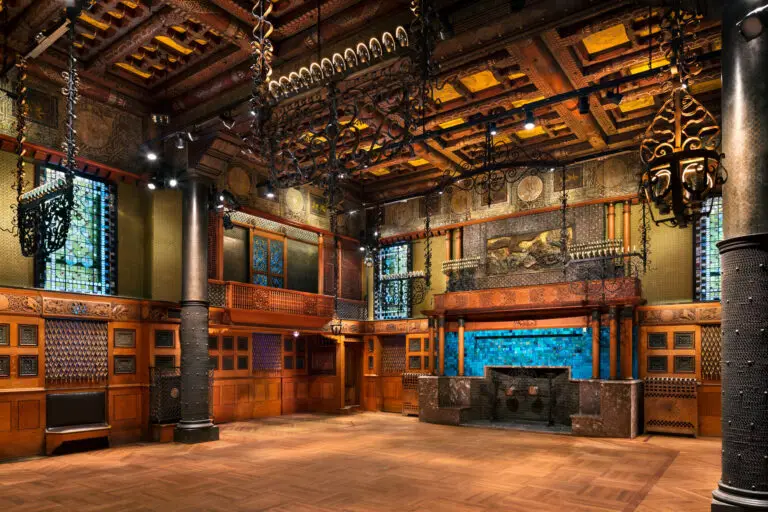
Finally, the musicians file out and a hush falls. Someone clicks their fingers in anticipation. A firetruck whirs in the distance.
According to Reich himself (reprinted in the glossy, gargantuan A3 program), “Music for 18 Musicians is based on a cycle of eleven chords played at the very beginning of the piece and repeated at the end.” Each chord is then “held for about five minutes [while] a small piece is constructed on it. When this piece is completed there is a sudden change to the second chord, and a second small piece or section is constructed.”
The piece marked Reich’s move away from the sometimes-abbrasive, percussion-forward minimalism of the sixties (of which Reich himself and Terry Riley were the main exponents). It is an undulating hour of slow chord progressions and layers, constructed, de-constructed, then re-constructed a little differently. It is hypnosis in music.
It takes a few minutes for the performance, heard in three dimensions like this, to come together in the ear and in the mind. Time is needed to shed the frenetic vibrations of life outside and adjust to this regimented, 210 beats-per-minute wave as it laps at our feet.
But after about 15 minutes, somewhere in Section IIIA, the whole thing suddenly makes sense, and we are jerked into Reich’s beautiful crystalline world. What we hear now is not 18 musicians but one orchestra.
Reich signals a change to the next chord with a floating chime, high up on the Marimba’s range, like church bells calling us from the fields. He has broken the dichotomy of percussion and melody – each violin is a drum; the maracas are one more note on many.
There is silent disbelief when the first performance comes to an end. The piece builds up so much momentum, such a head of steam, then seems to stop on a postage stamp: everyone drops out as if they’ve fainted, leaving a violin to fade out laconically, alone.
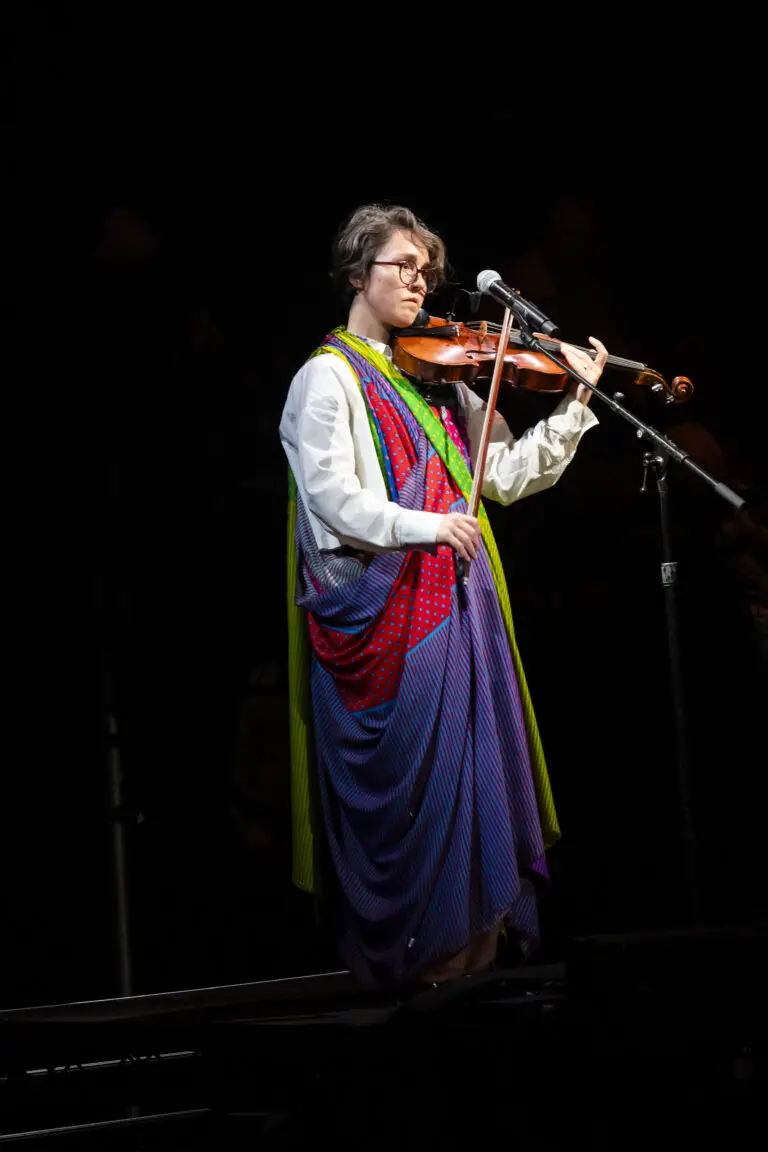
Instead of pause and applause, the piece melts into Viaduct, an improvised interlude by Caroline Shaw (also part of the Ensemble). Her performance involves chanting as other musicians build a tapestry of cloths, brightly colored, on her shoulders. Finally she picks up a violin and lapses into gorgeous vocal loops, a the natural descendent of Reich. She is not so much playing her violin as rubbing it, poking it.
This in turn moves into the second performance of 18 by Tactus from the Manhattan School of Music. This second “staging” explores the dynamic side of the work through players’ movements. And when I say movement I don’t just mean a light swaying on the seat or expressive eyebrow raising, no.
If the first performance was stately, charming, heartfelt, Tactus’ is hopeful, energetic, exploratory.
Tactus made use of every square inch of the stage (“stage” in this case meaning any space not taken up by the audience). The orchestra started off on the far side, but by Section II they have made their way, cellist and all, across towards me – swaying on their way like a New Orleans First Line.
(That these pieces are performed without a conductor, and in many cases without sheet music is, to me, staggering.)
The marimba players, unjustly rooted to the center through a conspiracy of weight and choreography, were energetic, bopping, leaning and grinning as much as anyone.
It all becomes genuinely exciting. The maracas player circumnavigates the stage at a brisk canter. I try to discern any relationship between the phase of his laps the music, but he has broken a full sprint (all the while holding time for the rest of the orchestra).
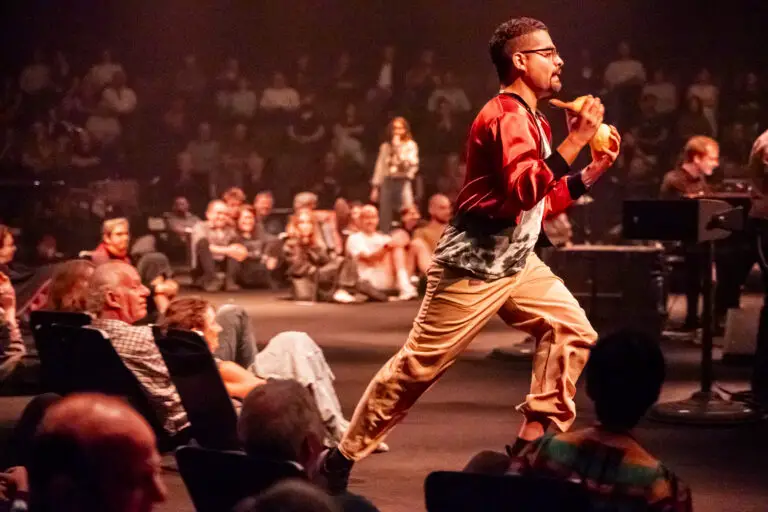
The result of all of this experiment is that – where the Steve Reich Ensemble produced a monolithic sound, all seeming to emanate from somewhere near the bottom of a bassoon, Tactus’ sound is distributed. They let us peer into the murky workings of the composition.
Finally, at the denouement, all players having broken into a full dance. I am blown away by the coordination of it all, of the sheer fitness of the musicians. The maracas player, clearly exhausted, gets an individual ovation as he takes his rightful place, spotlighted, in the center of the stage.
The third iteration, performed by Alarm Will Sound, explores the interaction between color, light and music. It is clear from the first two notes that they look to match the energy of Tactus, every member robed in sheets of bright cloth, and the piece is appreciably faster (which I think works best).
The spotlights for the first performance were a cold blue (“it’s impossible to fall asleep in this color,” I overhear a person in the row behind me say), and for the second a bright white, shining over everyone’s movements. Now they bathe one side now in warm orange light.
The pianist has her back to me and I can see a building block, one of Reich’s “low pulsing harmonies,” being constructed in real time with the expanding writhing of her shoulders. We are again in the thick middle of the composition: close your eyes and you can spread it all out, like cards on a table, and let each component flitter away to a different corner of the room. Choose where to focus.
Finally, the singers are amongst us now, spotlighted in the bleachers like mannequins in a nighttime shop window. This flush orange warmth spreads over the crowd like a sunrise.
It was only upon re-entering the space that its majesty fully struck me. I had stepped out to stretch my legs and eat a banana – this being a marathon not a sprint – and came back in to see, perhaps 60 yards still in the distance, this thick column of light, heavenly elements pulsating out. Musicians caught in the tractor beam. Tonight they are the chosen ones. I hope the farmer and his wife would approve.

Comments are closed.