


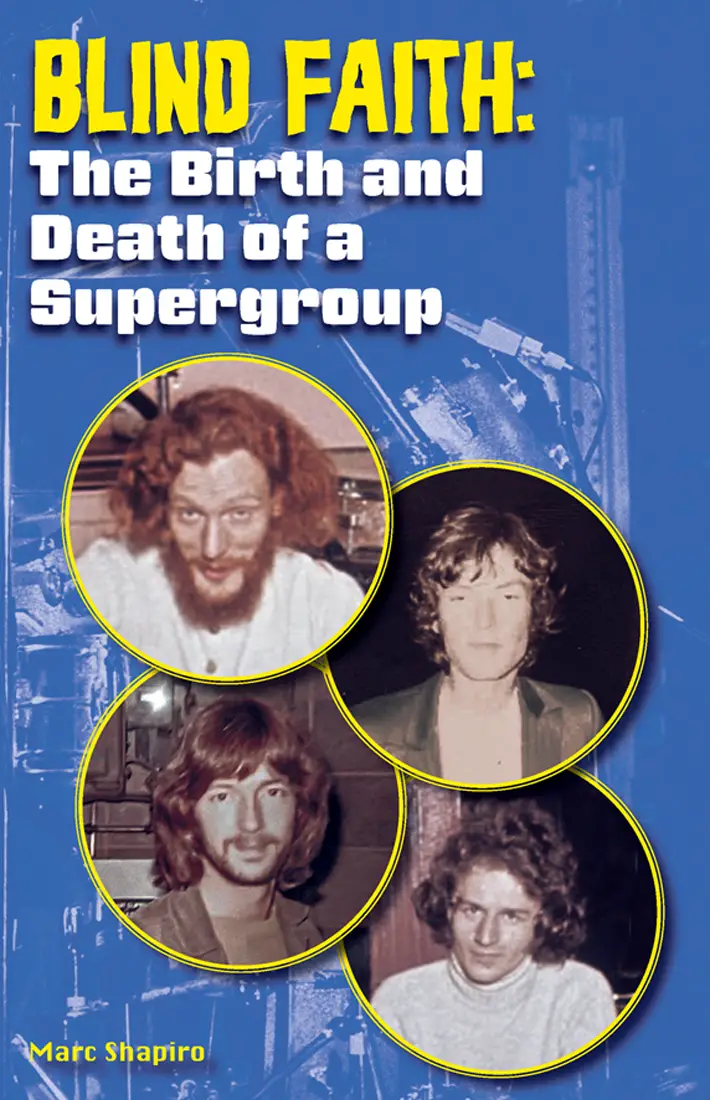
If you blinked, you might’ve missed them. They were the powerhouse British quartet that some claim was the first true supergroup, a fusion of the driving forces behind Cream and Traffic, a star-crossed aggregation that lasted less than a year, from preliminary jams to the recording of their one album and their one tour. Given their brief lifespan, credit goes to veteran music journalist Marc Shapiro for his latest, Blind Faith: The Birth and Death of a Supergroup (Wymer Publishing). It’s a slim but enlightening book that offers a fascinating, fact-heavy, and long-overdue eulogy for the greatest classic rock band that should’ve been.
Blind Faith came together in late 1968, when two blues-rock wunderkinds, Cream’s Eric Clapton and Traffic’s Steve Winwood, began informal jams after the demise of their respective groups. Clapton and Winwood had been circling each other for years and, in early 1966, collaborated as an ad hoc group, Powerhouse, on sizzling blues tracks featured on a compilation called What’s Shakin’.
After a few hangouts at Clapton’s country estate, the guitarist’s old Cream drummer, Ginger Baker, entered the picture. Did he, as legend claims, barge in against Clapton’s better judgment or was he enthusiastically embraced? The writer lays out the facts for both theories, with help on the latter from Nettie Baker, the drummer’s author-daughter, who has written extensively and informatively about her late father’s work and notorious personal legend.
The final piece comes when bassist Ric Grech joins, leaving his band Family on the advent of what should’ve been their breakthrough U.S. tour. According to the author, the band originally went without a bassist, with Winwood handling the low end on his organ pedals. Grech would bring both musical strengths and personal drawbacks. A solid, melodically inclined bassist, he also added a wonderful electric violin solo to one of my favorite Blind Faith tunes, “Sea of Joy.” Worse, he would become a drug-running buddy to Baker, and both would spiral deeper into heroin as the band reluctantly crawled through its one tour.
Through his writing and the closing Sessionography, we get a clear sense of how the band’s songs developed and were waxed. At an early get-together, Winwood brought in his classic “Can’t Find My Way Home.” The arrangement shifted from electric to acoustic during the album’s recording sessions, with this song alone occupying sessions from March to June 1969 before reaching its final form. Still reluctant as a songwriter, Clapton would arrive with a rough draft of another classic, “Presence of the Lord.” Originally titled “Lord Protector,” it would go through a whopping 72 takes, with the master being the 70th.
According to the author, Blind Faith didn’t succumb to a lack of talent; they succumbed to pressure from their management duo and the rush to write, record their debut, and hit the road.
Winwood’s manager, Island Records’ Chris Blackwell, was artist-focused, a man who gave his talent the time and space to develop. He served as the album’s original producer before wisely handing the reins to Jimmy Miller, who had produced Winwood in Traffic and the Rolling Stones.
The main culprit here was the other manager, Robert Stigwood. Stigwood managed Cream and Clapton, then went on to generate mega millions for acts like the Bee Gees by devising money-seeking yet artistically disastrous products like their movie remake of Sgt. Pepper.
If anything, these musicians needed a rest, time to unwind after the mammoth touring of their former bands, the space and quiet to compose music and find their groove. Before they were even partway through recording their debut disc, they announced a massive summer tour, running from June to August 1969. They had 10 days to record the album: six tunes in 42 minutes, four incredible originals, a dynamite cover of Buddy Holly’s “Well Alright.” As they ran short on time, they “padded out” their debut with a 15-plus-minute jam, “Do What You Like,” a return to the style of Cream that Clapton wanted no part of. He wanted out of the “Guitar God” spotlight and craved a group focused on low-key, soulful, authentic American music and songcraft, a group modeled on his favorite of the moment, The Band.
Shapiro recounts the sometimes comical, sometimes tragic details of two other misadventures involving Blind Faith.
The first is the original album cover, which featured a topless 11-year-old girl holding a phallic silver airplane, something that was promptly banned in America. The second was management’s bright idea to debut the still-young and very under-rehearsed group before a crowd of 100,000 at the Hyde Park memorial concert for the Rolling Stones’ Brian Jones.
Shapiro’s book takes us through the release of their debut album, which raced to the top of the charts despite mixed reviews. He then gives us the skinny on every stop on their tour, from the dry runs in Scandinavia to their cross-country U.S. journey, which took them to Madison Square Garden, the LA Forum, and everywhere in between. The author paints a fairly dim picture of their death march. Clapton was already out of the band in his head and heart, spending most of his time with the support act he would join right after the tour, Delaney & Bonnie. Winwood vainly tried to keep it moving but labeled some of their shows “vulgar, crude and disgusting.” Beginning with Hyde Park in June 1969, Ginger was back on the junk, joined by Grech. Still, his nightly drum solos seemed to get the biggest reaction from audiences, along with the Cream and Traffic covers the band ultimately added to their sets just to get through the nights.
In a book full of interesting tidbits, this one stood out. Blind Faith had been offered a spot at Woodstock, but Clapton was voted down by both his bandmates and management, who wanted a bigger payday than the organizers were offering. By the end of August 1969, the band had finished both its tour and its existence. A press release in October 1969 made it all public, bringing the band’s nine-month life to an end.
Shapiro has done extensive research to piece together Blind Faith’s brief life. While he doesn’t benefit from current-day interviews with the remaining members, his book is full of quotes from biographies and interviews with the band and its associates over the years. Along with the Sessionography, the book features a complete discography of the many reissues and bootlegs, both audio and video. It also includes a host of tear sheets from newspaper and magazine articles about the band and its tour dates.
If you listen objectively, you will realize Blind Faith featured some of the best music Clapton, Winwood, and Baker put down. The dueling guitars on “Had to Cry Today.” Winwood’s unparalleled vocals and Baker’s subdued, tasteful brushed drumming on “Can’t Find My Way Home.” Clapton’s rocket-ship solo on “Presence of the Lord.” These are some of the finest moments to emerge from the broad canon of British rock. These songs and Shapiro’s book remind us of what could’ve been if the stars had stayed aligned.
Pick up a copy of Blind Faith: The Birth and Death of a Supergroup here.

Comments are closed.