


When Billy Joel released “Miami 2017 (Seen the Lights Go Out on Broadway)” in 1976 as part of Turnstiles, it wasn’t positioned as a major hit. Over time, though, it has evolved into one of the most haunting and culturally resonant songs in his catalog — an apocalyptic love letter to New York City that feels more relevant with each passing decade.

The song imagines a dystopian future where New York collapses into chaos. Skyscrapers burn, the Hudson freezes, and its residents scatter south, with many ending up in Florida. Told from the perspective of a survivor looking back from Miami, the narrative carries a strange emotional duality —part nostalgia, part disbelief, part quiet acceptance. It’s speculative storytelling, but it never feels detached from reality. Instead, it lands with an emotional weight that suggests this future isn’t impossible, just deferred.
Musically, the track unfolds with a deliberate sense of control. It begins with a steady piano progression that anchors the song before gradually building with layered instrumentation. Guitars and percussion enter in waves, giving the track a cinematic quality that mirrors the escalation in the lyrics. There’s no explosive climax in the traditional sense; instead, the tension lingers, stretching across the song’s runtime and leaving the listener suspended in its aftermath.
Joel’s lyricism here is especially striking for its restraint. He sketches scenes rather than over-explaining them, offering glimpses of destruction that feel both surreal and grounded. References to burning churches, collapsing infrastructure, and public spectacles of disaster evoke a city unraveling in real time. Written during a period when New York City faced financial crisis, rising crime, and a general sense of instability, the song channels those anxieties into a speculative vision that, in hindsight, doesn’t feel all that exaggerated.
The meaning of “Miami 2017” has shifted repeatedly over the years, which is part of what gives it such staying power. It took on a particularly powerful resonance after the September 11 attacks, when Joel performed it at The Concert for New York City. In that moment, the song’s fictional destruction overlapped with real trauma, and its lyrics carried a weight that went far beyond their original context. It became less of a warning and more of a reflection.
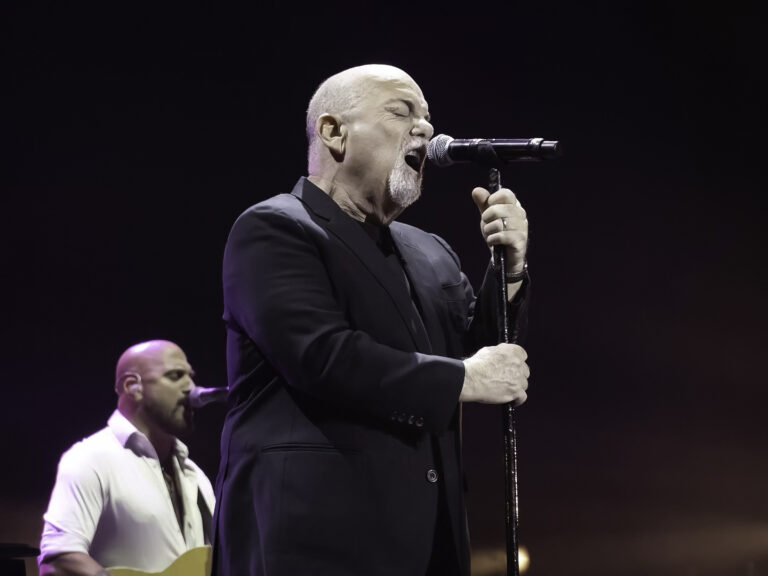
Despite never being a chart-topping single, the song has become a staple of Joel’s live performances. On stage, it often feels even more expansive, with extended instrumental sections and a heightened sense of drama. The audience’s reaction — especially in New York — transforms it into something communal. The story it tells no longer belongs solely to Joel; it becomes a shared meditation on the city’s fragility and endurance.
Within Turnstiles, the track stands as one of Joel’s most ambitious compositions. The album itself is deeply rooted in New York’s identity, but “Miami 2017” pushes that connection to its extreme by imagining the city’s absence. In doing so, it forces listeners to confront what New York means not just as a place, but as an idea. The loss of it, even in fiction, feels personal.
What makes the song endure is its ability to adapt. In the 1970s, it reflected fears of economic collapse. In the early 2000s, it echoed the emotional fallout of a city under attack. Today, it can just as easily be interpreted through the lens of climate change, mass migration, and the uncertain future of major urban centers. Each era finds something new in it, as if the song is constantly rewriting itself in response to the world around it.
And yet, for all its bleak imagery, there’s a subtle thread of resilience running through it. The narrator survives. He remembers. He tells the story. In that sense, “Miami 2017” is not just about destruction — it’s about preservation through memory. It suggests that even if a place disappears, its identity can persist in the people who carry it forward.
Nearly 50 years after its release, the lights are still on in Broadway. But the unease that Billy Joel captured in “Miami 2017” hasn’t faded. If anything, it’s become sharper, more immediate. The song doesn’t just ask what would happen if a city fell — it asks how close we might already be.
“Miami 2017 (Seen the Lights Go Out on Broadway)” lyrics
Seen the lights go out Broadway
I saw the Empire State laid low
And life went on beyond the Palisades
They all bought Cadillacs
And left there long ago
They held a concert out in Brooklyn
To watch the island bridges blow
They turned our power down
And drove us underground
But we went right on with the show
I’ve seen the lights go out on Broadway
I saw the ruins at my feet
You know we almost didn’t notice it
We’d seen it all the time on Forty second street
They burned the churches down in Harlem
Like in that Spanish civil war
The flames were everywhere
But no one really cared
It always burned up there before
I’ve seen the lights go out on Broadway
I saw the mighty skyline fall
The boats were waiting at the battery
The union went on strike
They never sailed at all
They sent a carrier out from Norfolk
And picked the Yankees up for free
They said that Queens could stay
And blew the Bronx away
And sank Manhattan out at sea
You know those lights were bright on Broadway
That was so many years ago
Before we all lived here in Florida
Before the Mafia took over Mexico
There are not many who remember
They say a handful still survive
To tell the world about
The way the lights went out
And keep the memory alive

Comments are closed.