


Few albums have been as misunderstood or unfairly dismissed as Billy Idol’s 1993 release Cyberpunk. This isn’t entirely surprising though. Rather than playing it safe, Idol created something bold, strange, and ambitious. In many ways, it was years ahead of its time.
The record experiments heavily with rock fused with electronic and dance elements, thus it showcases Idol fully embracing a new sound. Idol himself told the press in June 1993: “I threw off the shackles of the past… I was looking for a way to break the stalemate I’d gotten into, which was boring me to death, really.”
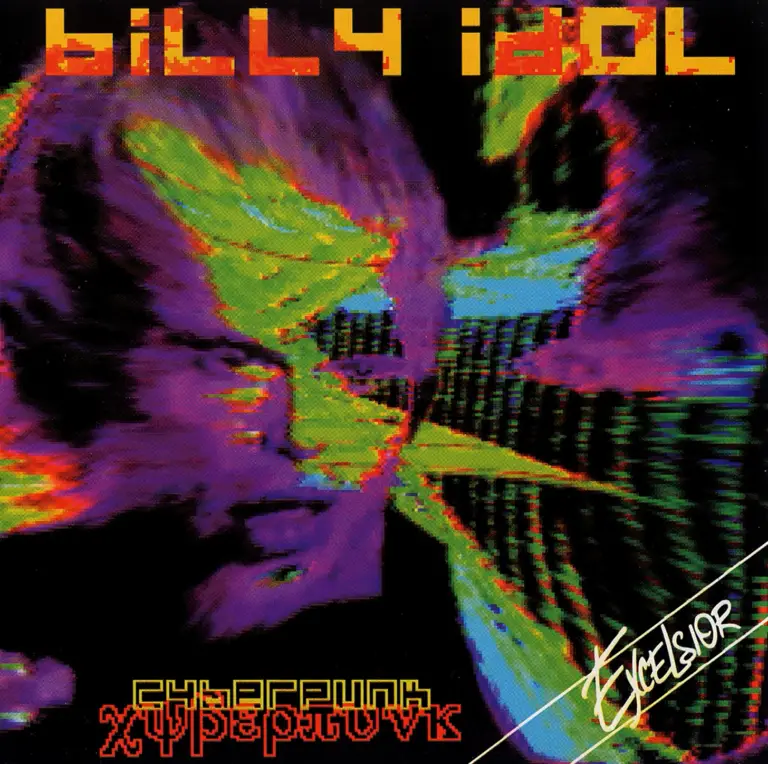
The production on Cyberpunk is one of the album’s greatest strengths. Dense layers of guitars collide with electronic textures and industrial rhythms almost effortlessly. Sampled dialogue, ambient soundscapes, and aggressive beats are peppered throughout the record, blending into something that still sounds surprisingly fresh (and quite unique) decades later.
What makes Cyberpunk especially impressive is the varied nature of its songs. Tracks like “Shangrila,” “Concrete Kingdom,” and “Wasteland” don’t follow predictable structures or formulas. Instead, they lean into atmosphere, experimentation, and mood. Therefore, creating something genuinely distinct within Billy Idol’s discography. Even when the album becomes messy or overwhelming, that chaos feels (somewhat) intentional, because Cyberpunk is built on risk-taking. One of the most ambitious tracks is the ambient-house piece “Adam in Chains,” which features a 2-minute and 53-second spoken-word introduction. This passage draws the listener into a hypnotic state before Idol’s vocals finally emerge. This arrival feels well worth the wait. His performance is tender yet jaded throughout the song, slightly haunting but also beautiful.
When experienced in its entirety, the album unfolds as a distinctive auditory journey, brimming with compelling ideas and great tracks. The songs may not all have the immediate hooks or commercial polish of Idol’s earlier hits, but there is something undeniably engaging and absorbing about them.
Looking back on the album, Idol noted in 2022 that its electronic elements were heavily influenced by rave music. At the time, however, the idea of Billy Idol merging rave-inspired sounds with his trademark rock style likely alienated listeners who were expecting a more conventional follow-up to his earlier work.
As such, Cyberpunk may not be Billy Idol’s most accessible album sonically, but it may well be his bravest (and arguably his most fascinating). Despite its blend of genres and styles, it underperformed commercially upon release. Cyberpunk missed the Billboard Top 40 entirely. In Europe, however, it reached the Top 20 on the European Albums Chart, peaking at number 11.
It still sold over 100,000 copies in the US. While this was far from his commercial peak, it nonetheless demonstrated that a substantial portion of his audience was willing to follow him into this more experimental direction.
If the record alienated parts of the mainstream, it succeeded in highlighting Idol’s commitment to artistic expression. Had he delivered the straightforward rock album many fans and critics were expecting, another hit was likely. Instead, he chose to make the record he wanted to make! Embracing the sounds, influences, technologies, and ideas that were inspiring him at the time.
That willingness to take risks is the hallmark of a true artist. Rather than repeating a proven formula, Idol pushed himself creatively and produced an album unlike anything else in his catalogue. In doing so, Cyberpunk revealed the breadth of his artistic vision and showed that his identity (and musical sound) far extended beyond the fist-pumping rock-star image that first made him famous.
Perhaps the most remarkable thing about Cyberpunk is how prophetic it now feels. Its themes of internet culture, digital identity, technology shaping human connection, and online communities were explored years before they became part of everyday life. What was once dismissed by some as excessive or self-indulgent in 1993 now feels surprisingly visionary. At the time, the internet was far from a household technology, existing in a transitional phase between a specialist academic network and the global communications system it would become. While the idea of the “Information Superhighway” was beginning to enter public consciousness, access remained limited. In the United States, only around 2.3% of the population used the internet.
Against this backdrop, the inclusion of an email address and a floppy disk with the limited-edition Cyberpunk CD was remarkably forward-thinking. At a time when most listeners had little or no experience of the online world, Idol was already attempting to integrate emerging digital technologies into the album experience, making Cyberpunk feel decades ahead of its time.
It is also time listeners gave the album another chance. Those who enjoy more recent Depeche Mode releases, IAMX, Massive Attack, and dare I say The Prodigy may be surprised by just how strong Cyberpunk really is. The same applies to anyone who appreciates music that sits a little outside the mainstream! It is far more rewarding than its reputation suggests!

Comments are closed.