


Led by front man Josh Kaye, Baklava Express is a Brooklyn based instrumental band delivering a thoughtful mixture of Turkish, Arab, Jewish, Greek, and more sounds with a modern kick. Their new album, Sabába, is an eight track hit with something for everyone.
Sabába combines the old and the new, artfully blending Middle Eastern textures without sounding stale or derivative. In a soundscape so crowded with noise and constant demands on your attention, they offer something rarer: music that lets you reflect, relax, and be carried away by age-old textures in delightful ways.
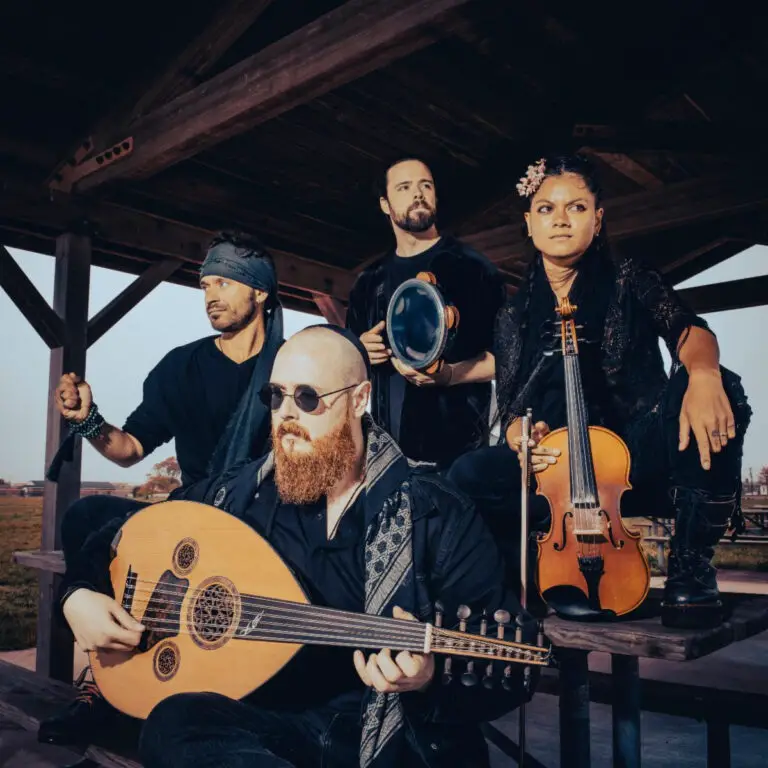
The band’s diverse makeup, a mix made possible in the wacky world of Brooklyn’s musical underground, is one of its greatest strengths. Kaye leads on guitar and oud, joined by Daisy Castro on guitar, James Robbins on bass, Eren Erdogan on kaval and other wind instruments, and Jeremy Smith on percussion — between them, a fluency in jazz manouche, Turkish classical music, Afro-Peruvian rhythm, and just about everything in between. “These are all original songs,” Kaye explains, “but the rhythms and melodic lines may, at one moment, evoke Turkish, Greek, or Armenian traditions, and then, just as naturally, turn on a dime to reference Arab, Mizrahi and Sephardi folk music, or make discreet nods to jazz, flamenco, or rock.” [Read more on New York’s global soundscape]
The title track is a standout. “Sabába” is sick, evoking medieval Europe at moments, but still riding the minor seventh scale with the oud front and center. Like all of the album, the Middle Eastern influences run deep, but their varied instrumentation lets them take it somewhere modern. Crisp, clean, evocative of the region without being trapped by them, “Sabába” is a real musician’s composition.
The album also carries something bigger than just musical fusion. “At a time when our encounters and differences across cultural lines are so often framed by anger and mistrust, the music of Baklava Express suggests an open invitation to a shared space,” Kaye says. The songs have no lyrics — a nod to niggunim, the mystical Jewish tradition of wordless singing extends that invitation. The absence of language is the point. For another niggunim we love, check out Yoel’s Niggun by Brooklyn Hasidic folk-rock band Zusha.
Kaye’s path to this sort of music is its own story. A professional guitarist in New York for years, he kept running into Arab music in Brooklyn until it ran into him. “One day I was walking home from a gig in my neighborhood, and I walked past the barber shop of an Egyptian man. The shop was closed, but I could see he was in there with his friends, playing music on the oud. He saw me looking and waved me in. We talked, hung out, and I tried to play the oud, but I couldn’t. But that night, on impulse, I bought one on Amazon.” From there, obsession took over.
He reflects on this background in “White Sauce Hot Sauce,” which captures the experience of ordering from one of Brooklyn’s many Halal Carts, part of the multi-ethnic traditions that gibe Brooklyn its unique character.
After a few years of serious dedication, he was getting called for weddings and parties, and eventually the writing followed. “I’ve always been a composer,” he says, so picking up the oud as a songwriting tool was the natural next step.
That return to tradition is all over “A Very Narrow Bridge,” which the band describes as drawing on the East European Ashkenazi experience. It sounds like a slightly more melancholic European folksong than the rest of the album, less minor sevenths, more of a dance rhythm and time signature, a Western melody threading through.
“Nistar” takes a different approach, leaning into a classic Turkish song and letting the traditional repeated melodies and their variations do the talking. “Then Begin Again” shows maybe most clearly what Baklava Express is actually doing. It opens like a Turkish love song, the oud drifting into something more Arab, before making a strong bridge to a fully modern song — rocky percussion, an almost anthemic melody resolving from the dissonance, but still carrying Aegean-inflected melody. Kaye describes it as having “a kind of modern Turkish sensibility” in the melody, before, “kind of halfway through, it becomes a slow rock song.”
The players Kaye has assembled are each serious on their own terms. Castro has been in the Django community on both sides of the Atlantic since she was young, and her repertoire runs from Django to salsa to Turkish music. Erdogan, born into a musician family in Turkey, trained at Istanbul Haliç University’s Traditional Turkish Music Conservatory and brings kaval, ney, duduk, and more to the record — instruments that give Sababa much of its geographic reach. Robbins on bass has played with Clark Terry, George Benson, and Freddie Hubbard. Smith, a Juilliard graduate, moves between Middle Eastern fusion, Afro-Peruvian ensemble, and global jazz.
Kaye himself, from London but now long based in New York, tours nationally with the Stephane Wrembel Band and has appeared at The Town Hall, Dizzy’s Club, The Blue Note, and Lincoln Center’s Rose Theater. His compositions have appeared in Woody Allen’s Rifkin’s Festival and the video game Call of Duty: Wild Dogs. Sabába is the clearest statement yet of what he’s been building.
Sabába is out now on all streaming platforms. Baklava Express has already begun to take their instrumental album on the road, featuring a successful album release party in Brooklyn Thursday. They have upcoming shows in New York, Connecticut, and Vermont through the end of May.
Baklava Express Tour Dates
Apr 24: MT. KISCO, NY – Jazz on Main
May 7: NYC, NY – Drom
May 17: NYC, NY – Greek Jewish Festival 2026
May 29: PUTNEY, VT – Next Stage
May 30: MILFORD, CT – The MAC

Comments are closed.