
On the cusp of the 250th anniversary of America’s independence from England, the mood in these United States isn’t as patriotic as you’d expect for such a milestone event. Take your pick for why there’s a lack of enthusiasm for the semiquincentennial – the state of the economy, the resident of The White House, generally poor planning for Washington D.C. events, tension over ICE and other unpopular policies, a decrease in patriotism – and you can understand why this weekend’s celebration is just another 4th of July for many.
Things were different in 1976 for the Bicentennial – war in Vietnam had ended, troops and POWs came home, Ford was president and the shadow of Nixon’s presidency had gone away. Skip ahead 50 years, and we’re going through the motions, celebrating the 4th with barbecue, fireworks, gatherings of family and friends, and live music.
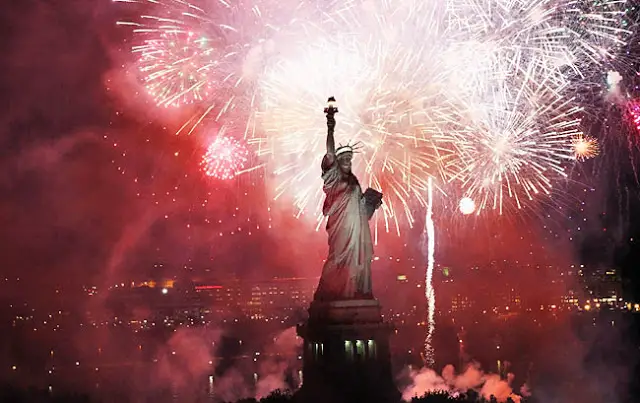
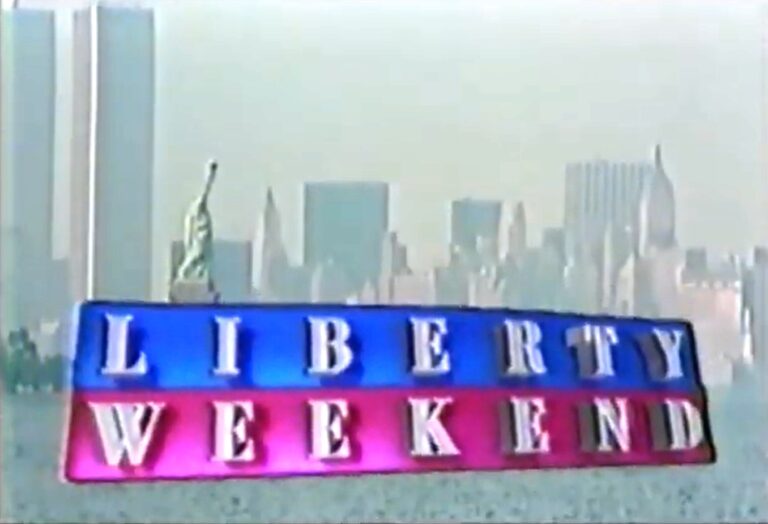
Back in 1986, Liberty Weekend revived the celebratory feeling in the nation of 1976, with a four-day celebration centered around the restoration of the Statue of Liberty. The spectacle celebrated the long France-U.S. friendship, brought together luminaries and celebrities to Liberty Island and venues around Manhattan, and saw an incredible amount of music performed that recalled America’s history and celebrated the nation’s 210th anniversary.
The Statue of Liberty – Origins and 50th Anniversary
Her 100th birthday was in 1986, so Lady Liberty will be 140 years old this year, not looking a day over 92. Her story starts in Paris, France, where on July 4, 1884, the statue was presented to the United States through American minister to France Levi Morton, before being dismantled and shipped across the Atlantic Ocean to New York City in 1885. After a year of assembly, on October 28, 1886, President Grover Cleveland dedicated the Statue of Liberty on Bedloe’s Island in New York Harbor.
The pedestal under the Statue would be designed by American architect Richard Morris Hunt, with fundraising assisted by the efforts of Joseph Pulitzer and Emma Lazarus, who would write The New Colossus in 1883 to assist in fundraising, later being added as a plaque at the pedestal base of the Statue in 1903.
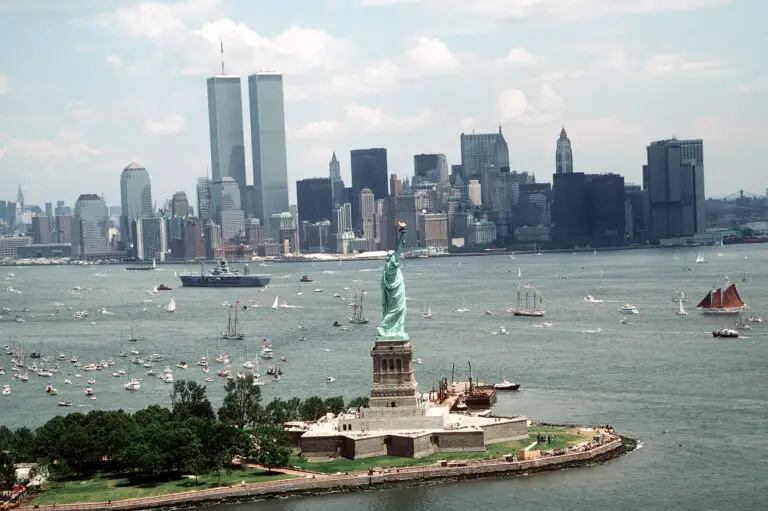
An icon for immigrants arriving to American, more than 13 million who arrived through New York Harbor between 1886 and 1924 would see this beacon of hope through her raised torch, reassuring these new Americans. The “Mother of Exiles” was honored on her 50th anniversary by former New York governor and then-President Franklin D. Roosevelt, with a 1936 speech that would cement the Statue as an icon of immigration.
To restore the Statue of Liberty, fundraising for the renovation and preservation efforts began in 1982, with scaffolding surrounding the exterior while work began inside, particularly to reverse and prevent corrosion of the copper figure. And while the statue did not return to its original bronze color (the thin ‘skin’ could not be polished) the green giant would be celebrated for four days with all the pomp befitting a national symbol.
July 3
Opening on July 3 at Governors Island with French President Francois Mitterand in attendance, The Liberty Orchestra, conducted by John Williams, premiered a new commissioned composition, “Liberty Fanfare”. (The piece actually premiered on June 4 with the Boston Pops)
Before the July 3 performance of the five-minute piece, Williams said that he had “tried to create a group of American airs and tunes of my own invention that I hope will give some sense of the event and the occasion.” The result was a composition that received positive reviews and is still performed as a patriotic number.
Listen closely at the start and you’ll hear a sound that mimics the actual sound of the Liberty Bell.
N. Brock McElheran, a music professor at the Crane School of Music at SUNY Potsdam conducted “The Liberty Weekend Chorus” which included some alumni of the Crane School in the performance. Kenneth Mack Jr. sang the National Anthem while Gregory Peck, Elizabeth Taylor and Frank Sinatra spoke; Ol’ Blue Eyes sang “The House I Live In,” a song from a short 1945 movie of the same name, with lyrics by Abel Meeropol, born to Ukrainian-Jewish immigrant living in The Bronx, and also the writer of “Strange Fruit,” made famous by Billie Holiday.
Sinatra spoke, noting that the Statue smiled down on Sinatra’s father, as he arrived to America on a ship from Sicily in 1905, reflecting on the thrill of stepping in ‘Liberty Soil,’ the hopes and dreams of this new land, enriching the American family through their shared experiences and pilgrimages to freedom.
Other musical performances on night one of Liberty Weekend would follow from Neil Diamond, singing “They’re Coming to America”, Larry Gatlin singing “Freedom”, Jose Feliciano and Diane Schuur singing a duet of “The American Wedding Song”, plus ABC News anchor Ted Koppel presenting the Medal of Liberty to outstanding naturalized citizens and Chief Justice Warren Burger presiding over a naturalization ceremony at Ellis Island.
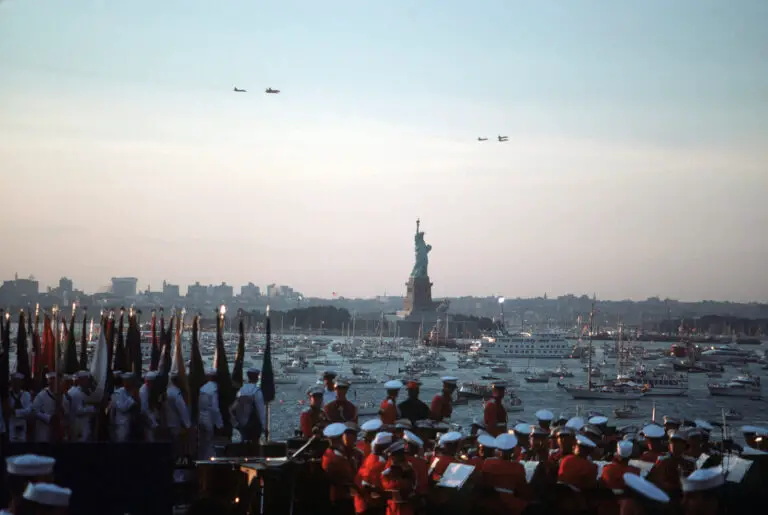
The symbolic lighting of the Statue of Liberty’s torch was done from the USS John F. Kennedy, with a fireworks display set to “The Stars and Stripes Forever” by John Philip Sousa.
July 4
Amid a flotilla of tall ships, sailing ships and battleships, Liberty State Park in New Jersey, on the banks of New York Harbor, found more than 200,000 people having a gigantic picnic from dawn til dusk, with a legendary performance by The Boston Pops and others that evening, plus fireworks of course.
The Pops was conducted once again by John Williams, playing the music of America’s greatest composers, including Sousa, Duke Ellington, Aaron Copland and George Gershwin.
Then there were performances from John Denver (“America the Dream Goes On”), Melissa Manchester, Clamma Dale and Simon Estes, Joel Grey (a George M. Cohan medley), Whitney Houston (“The Greatest Love at All”), Johnny Cash (“Ragged Old Flag” and “The Battle Hymn Of The Republic”) and Barry Manilow (“America the Beautiful/One Voice”), a broad range of American music and artists from all walks of life.
Liberty Park was the scene of an “All-American people’s picnic” with 15,000 lucky ticket holders, who won admission to the concert in a lottery, spanning across the south lawn of the Park. Tens of thousands found places off the access road or on the banks of the harbor who were eager to see the Statue of Liberty and hear the music celebrating the biggest 4th of July since the first one.
July 5
Since July 4 is a federal holiday, the Statue itself was not open, so on July 5, the Statue of Liberty was reopened to the public, accompanied by the Paris Boys Choir and Harlem Boys Choir. “The Great Blimp Race” sailed down a 12-mile course along the Hudson River during the day
The Great Lawn in Central Park found Kirk Douglas and Angela Lansbury hosted a Classical Music Salute to Liberty later that evening, with a then-world-record crowd of 800,000 who looked to see performances by the New York Philharmonic conducted by Zubin Mehta. Other works performed include those by Beethoven, Bizet, Haydn, Verdi, Sarasate and Puccini, as well as patriotic songs, spirituals and pop songs.
“The cornucopia of festivities in New York seemed to make other Fourth of July celebrations around the nation pale by comparison. Being at the center of the national celebration seemed to add an extra lilt to the delight of New Yorkers. A gigantic street fair occupied the southern tip of Manhattan.”
“Endless crowds streamed into the canyons of the financial district, filling 50 blocks decorated with balloon arches and echoing folk music. The organizers of the Harbor Festival had predicted that more than 2 million people would come to the festival over the Fourth of July weekend”
New York Times, July 5, 1986
Performing with the Philharmonic were tenor Placido Domingo, mezzo-soprano Marilyn Horne, cellist Yo-Yo Ma, baritone Sherrill Milnes, soprano Leona Mitchell, violinist Itzhak Perlman, the New York Choral Artists and the U.S. Army and Marine Bands.
Meanwhile in New Jersey, John Williams once again conducted the “Liberty Fanfare” in Liberty Park
July 6
To cap off the holiday weekend, on Sunday, July 6, closing ceremonies took place at Giants Stadium in East Rutherford, NJ, with sports greats appearing via telecast from the Brendan Byrne Arena.
John Williams once again conducted “Liberty Fanfare” with dancers and a drill team, plus the singing of the National Anthem by a chorus of 1000.
Among the celebrities and performers on the final night of Liberty Weekend were former teen idols Fabian Forte and Frankie Avalon, clarinetist Buddy DeFranco, actor Charlton Heston, country legend Waylon Jennings, prolific dancer and actor Gene Kelly, Godmother of Soul Patti LaBelle, saxophonist Gerry Mulligan, Willie Nelson, Kenny Rogers, The Pointer Sisters, Manhattan Transfer, The Golden Boys of Bandstand, Shirley MacLaine, and Liza Minnelli, who closed the night with “New York, New York”
How did July 4, 1986 become an event representative of the expansive music history of America? Liberty Weekend was executive produced by David L. Wolper, the son of Eastern European Jewish immigrants to New York City, and had previously produced the opening and closing ceremonies for the 1984 Summer Olympics in Los Angeles.
With patriotic bonafides that included a film version of JFK’s A Nation of Immigrants and Oscar-nominated The Race for Space, as well as work producing episodes of The Grand OId Opry and Roots, Wolper likely deserves credit for taking a broad brush to paint a variety of music and performances that were representative of the whole of America, not a limited segment. The eventual Tricentennial committee could learn a great deal from how Liberty Weekend was etched into the American story.
Bluesky Discussion
View on BlueskyNo replies yet. Be the first to comment on Bluesky!

Comments are closed.