


Music has always been a vehicle for telling stories – of love and heartbreak, of history and fantasy, and much more. Sometimes the stories can be related in a tuneful single lasting under three minutes. In other cases, beginning in the late ‘60s, these stories could unfold across a dozen interconnected songs, an audio movie or novel on four or more sides of vinyl. In time, these bodacious pieces would become a genre unto themselves – some beloved, some the object of seemingly endless ridicule.
Now, some of the best and least known examples of this ambitious musical form are the subject of a new book: What’s the Big Idea: 30 Great Concept Albums by Bill Kopp (HoZac Books).
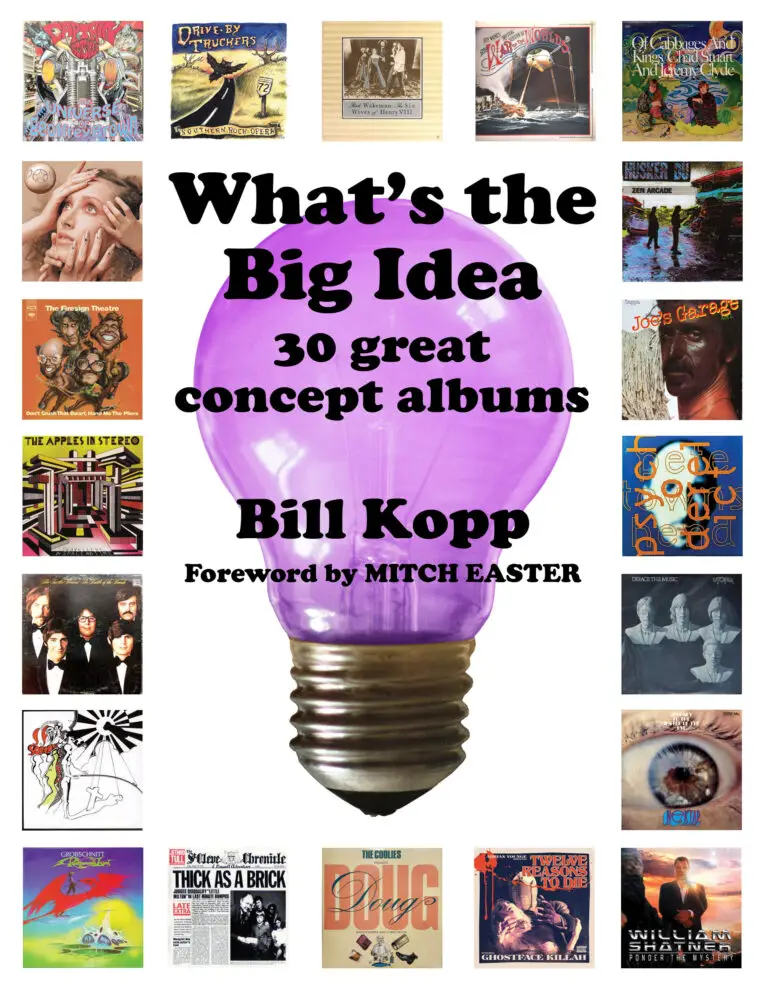
Kopp begins by defining a concept album in terms that are broader than some people’s idea of the category. “A concept album can be a collection of songs built around a single theme, mood, idea, or set of things.” It could be a collection of songs in which an artist assumes a temporary persona, like The Beatles’ Sgt. Pepper’s or the supreme example, a “rock opera” with a vague narrative, such as The Who’s Tommy, Pink Floyd’s The Wall, Frank Zappa’s Joe’s Garage and the Smashing Pumpkins’ three-disc Atum. The author believes that an unlikely artist and entry may have birthed the whole genre, Frank Sinatra’s 1955 classic, In the Wee Small Hours of the Morning. It is a fantastic 16-song LP centered on the themes of love and loss, with a unified, after-midnight musical mood. In 1968, the mighty Sinatra even took a shot at a narrative song cycle, a sort of easy-listening pop opera, if you will, with one of his worst-selling albums, Watertown, a disc now getting belated cred courtesy of today’s crate-digging hipsters.
Kopp’s journey through the world of concept albums provides a wide range of examples, some well-known and vintage, others way more obscure and surprisingly current.
The idea for prog rock keyboardist Rick Wakeman’s The Six Wives of Henry the Eighth came not from the artist himself but from his record label head, a savvy businessman who was looking to cash in on the popularity of the group he was then playing with, Yes. Wakeman penned the instrumentals that comprised the album while on tour with Yes, while reading a book on the fates suffered by the nasty King’s many wives. The label didn’t like or promote the record, but it took off after Rick performed it on Britain’s top TV music showcase, The Old Grey Whistle Test. In the U.S., it emerged as a hit thanks to the burgeoning FM radio world, whose DJs delighted in spinning long tracks.
Rick Wakeman OGWT 1972
Jethro Tull’s Thick As A Brick was created as a parody, a “piss-take” on the whole genre, according to the band’s visionary, Ian Anderson. With no track breaks and entire sides of continuous music, it was viewed as “commercial suicide” by the band’s record label… yet it became their first #1 album. In the late ‘60s, even seemingly lightweight pop duos like Chad and Jeremy would get in on the act with Of Cabbages and Kings and its even better follow-up, The Ark. For the former, the classically-trained Chad Stuart would flex his musical muscle under the guidance of Byrds/Beach Boys producer Gary Usher. It marries his classical arrangements and world-music touches, like sitar, with California surf harmonies and Britain’s old-world whimsy. Lyrically, it explores serious themes like ecology, overpopulation, and apocalypse, with spoken-word passages courtesy of the legendary Firesign Theater. The comedy group’s Phil Proctor was Stuart’s roommate in an LA mansion at the time.
Chad and Jeremy “Rest in Peace”
William Shatner wasn’t only known for his sometimes-overwrought acting on Star Trek, but for his offbeat, unintentionally hilarious musical ventures like his 1968 debut disc, The Transformed Man. In his book, Kopp explores Ponder the Mystery, Shatner’s quite good collaboration from 2013 with ex-Spooky Tooth and Foreigner multi-instrumentalist Billy Sherwood. Here, Shatner’s cosmological poetry is paired with some truly excellent sounds created by an all-star cast including guitar gods Steve Vai, Robby Krieger, Vince Gill and Al Di Meola, Hawkwind’s Nik Turner, jazz great George Duke, the aforementioned Rick Wakeman, Tangerine Dream’s Edgar Froese, and even Captain Beefheart alum Zoot Horn Rollo.
Shatner – “Ponder the Mystery” Video
In discussing the many opus-sized works of Pete Townsend, Kopp doesn’t go with the legendary first rock opera, Tommy or its follow-up Quadrophenia, but with his 1993 work, Psychoderelict. Negatively reviewed at the time of its release, it is about the fictionalized representation of Townsend’s conflicts with fame, an obsessed fan and an even more obsessed journalist. The concept would work better when it was re-released without its weighty spoken word passages (on a music-only CD) and as a staged radio play at the Brooklyn Academy of Music.
One of the best things discovered in this book was the Apples in Stereo’s 2010 Travellers in Space and Time. It would be the group’s seventh and final album before its leader, Bob Schneider, largely left music for a career as a math professor. It drew inspiration from an earlier rock opera, 1974’s The Butterfly Ball and the Grasshopper’s Feast, by Deep Purple’s Roger Glover. The music is a combination of the early analog synth stylings of Wendy Carlos, Kool & the Gang R&B, and Electric Light Orchestra future pop. The latter is most evident in the expansive, robotic harmonies produced with a Vocoder, a la ELO’s “Mr. Blue Sky.”
Who knew that the maligned Southern Rock genre spawned an opera of its own, courtesy of the Drive-By Truckers? In 2001, they did what they called “the un-coolest thing” imaginable and created Southern Rock Opera. It is a fictional tale inspired by the real-life tragedy of Lynyrd Skynyrd, the Southern Rock band that met their fate in a plane crash. As the Drive-By Truckers record label had no interest in it, the band turned to crowdfunding to pay for its production and a limited distribution. They even added a third guitarist to their line-up to capture the Skynyrd sound. Unfortunately, released on 9/11, the album would go on to garner great reviews and a broader release.
The above is just a taste of the sonic wonders and WTFs that Kopp turns readers on to. Other standouts are his critiques of Husker Du’s Zen Arcade, Nektar’s Journey to the Centre of the Eye, the Avett Brothers’ Mignonette, The Hold Steady’s Separation Sunday and Ghostface Killah’s rap opera, Twelve Reasons to Die.
Kopp’s latest does what any great book about music should. It opens the door to new sounds that will deepen your appreciation of the most excellent of art forms – music.

Comments are closed.